Car Parking Shade Size Guide: How Big for 1, 2, 4 or 10 Cars?
By the MTE engineering team · Updated · 5 min read
As a rule of thumb, plan about 3 m of width per car and 5.5 m of depth. That makes a 1-car shade roughly 180 sq ft, a 2-car shade about 330 sq ft, a 4-car shade about 650 sq ft and a 10-car double-row shade about 1,750 sq ft. Send us the size and a few photos and we will suggest the right design.
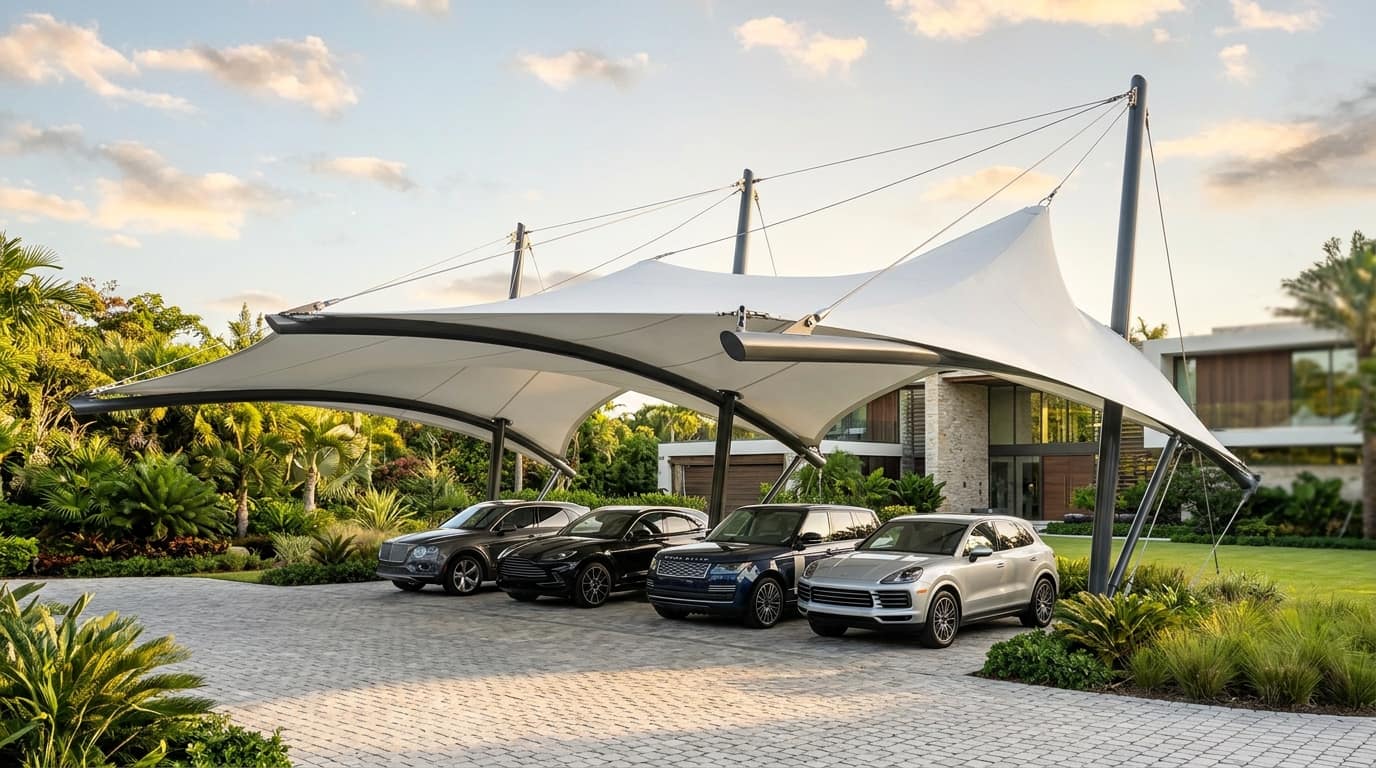
Start with the car, not the shade
Most sedans in Pakistan are about 4.5–4.8 m long and 1.8 m wide; larger SUVs and double-cabin pickups are close to 5 m long. A shade must cover the full length, leave room to open the doors, and clear the roof of the tallest vehicle.
Our standard cantilever arm is 5.5 m deep with 2.4 m front clearance, which covers SUVs and 4x4s comfortably.
Typical sizes
| Cars | Typical size | Area (approx.) | Common design |
|---|---|---|---|
| 1 car | 3 m × 5.5 m | ≈ 180 sq ft | Single cantilever or wall-mounted |
| 2 cars | 5.5 m × 5.5 m | ≈ 330 sq ft | Single cantilever |
| 4 cars | 11 m × 5.5 m | ≈ 650 sq ft | Single cantilever, 2 bays |
| 10 cars (double row) | 15 m × 11 m | ≈ 1,750 sq ft | Double cantilever or butterfly |
What changes the size you need
- SUVs and pickups need more depth and front clearance than small cars.
- Leave space to open doors fully, especially next to a wall.
- A gate, a tree or a balcony may limit where columns can stand.
- If you may add a car later, size the steel for the extra bay now.
Measure your space in 5 minutes
- Measure the width available, wall to wall or edge to edge.
- Measure the depth from the back wall to where the car nose stops.
- Note the gate width and anything overhead: trees, wires, balconies.
- Take two or three photos and send them on WhatsApp with the measurements.
Send your measurements and photos to +92 302 4001063 and we will reply with a design suggestion and estimate.
Related
Frequently asked questions
What information do I need to provide?
City and specific location, approximate dimensions or area required, intended use (parking, garden, pool, commercial, etc.), any budget range you have in mind, and photos of the space if available.
Do you visit the site before quoting?
For projects above a certain scale, a site visit is essential. For smaller residential projects, good photos and dimensions are often enough to prepare a preliminary estimate.